
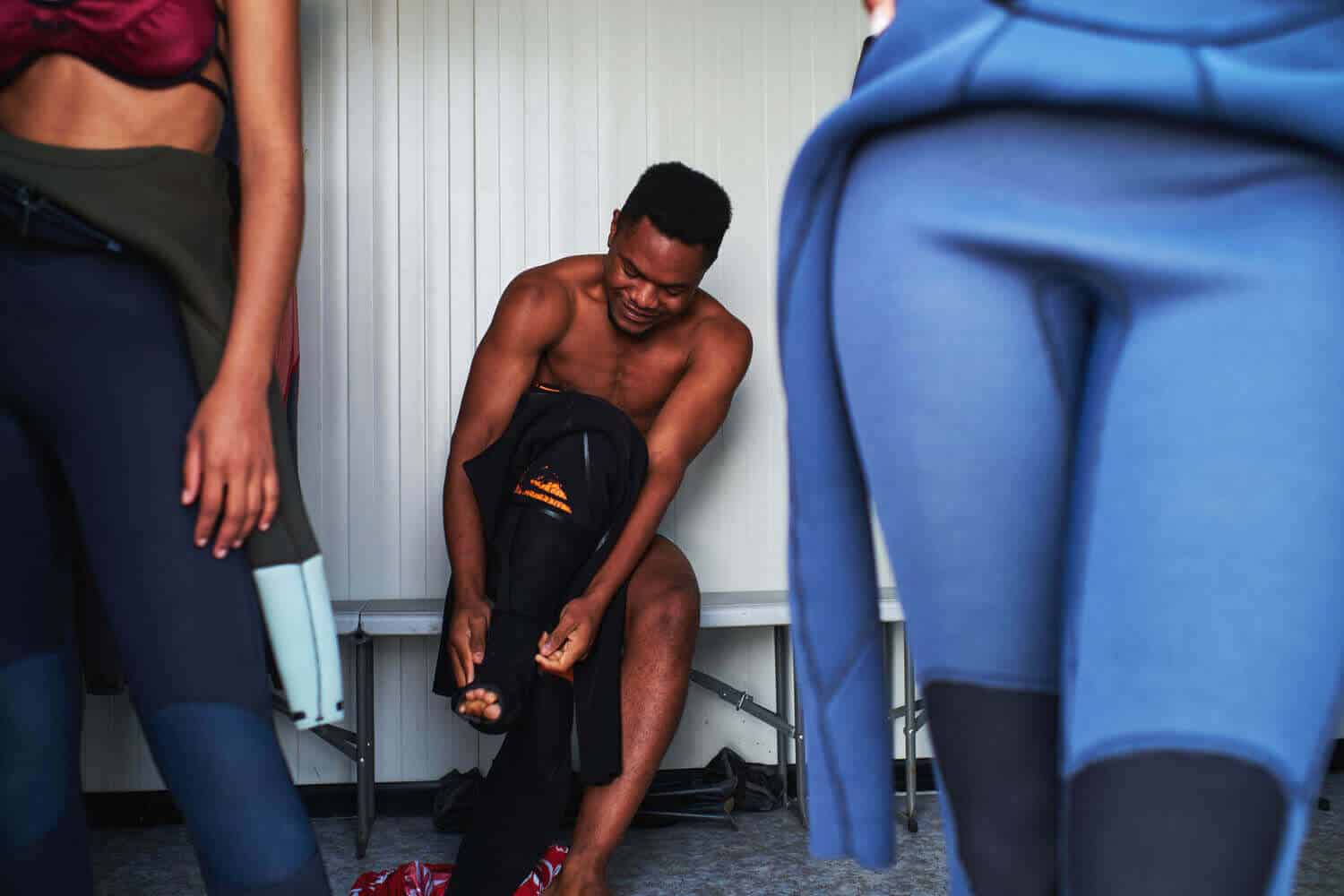
If you are new to wearing a wetsuit, we understand how it can be something of a daunting prospect to actually put it on and of course, to eventually take it off! Panic not the following guide is designed to help!
Before you start wiggling into your new wetsuit, please take a few moments to read our Wetsuit Buyers Guide which covers some of the important points when choosing a new wetsuit, such as size, fit, construction etc. as these considerations will potentially make the difference between your wetsuit feeling like a second skin vs some kind of hell!
So Lets Get In!
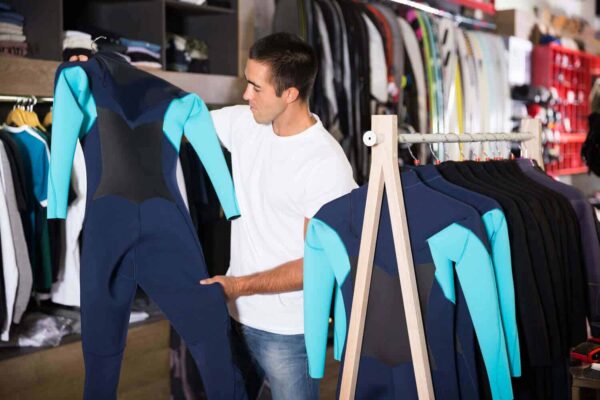
Step 1: Getting Ready
For all wetsuits, make sure they are not inside out i.e. the outside should be facing out and the inside facing in! (Remember, if youre trying on a suit which has already been used, it may have been washed out and turned inside out to dry!)
NOTE: Some people prefer to sit down if trying on a wetsuit for the first time, just for the first part, preventing you from wobbling over!
Back-Zip Wetsuits
- Make sure the suit is fully undone at the back – this may include a velcro closure at the top of the neck and the zip. Undo and unzip it all the way, as far down as possible.
- Roll the top of the suit down to roughly the waist so you can see more of the inside of the suit and the foot opening.
Chest-Zip/Chest-Closure Wetsuits
- Make sure the wetsuit is open as much as it can be, by either unzipping the chest-zip and/or opening the velcro closures too (if applicable).
- Also check that any pull-tighteners/toggles are as loose as possible.
Zip-Free Wetsuits
- All you can really do here, is to identify which side you will enter, making sure any pull-tighteners/toggles are loosened right off.
- Make sure your suit is round the right way i.e. the front is at the front – these suits are easier to confuse the back and front than those with more obvious orientations!

Step 2: One leg at a time
- From a standing or sitting position, insert one leg – youll need to use your hands to gradually persuade and work the neoprene up your leg, to allow your foot to pop out at the ankle.
- TIP: take care not to damage the neoprene with sharp nails/jewellery.
- Once your foot is out, you can again work the wetsuit up to around your mid to upper thigh. Take care to tease out any ripples or rolls of neoprene as you go, as the suit will not fit you properly with baggy areas.
- Now insert your other leg and repeat.
- Make sure to line up any of the padded/reinforced areas correctly, such as the knee pads should sit over your knees etc.
- TIP: If you have very sweaty feet, or if youre getting into a wetsuit thats already wet, you might find it easier to put plastic bags over your feet to encourage them to glide on through (removing them before you leave the changing room is advisable)!
Step 3: Moving on up
- Once you are in up to your thighs keep working the neoprene up to your waist, unfolding/smoothing out as you go.
- You will feel the contours/shaped panels of the wetsuit settling into place as it rises over your hips, with the seam fitting snugly in between your legs at the crotch.
- TIP: your suit shouldnt be super tight at the crotch so that it pinches/hurts, but equally there shouldnt be any really loose material either. Just like life, its all about balance!
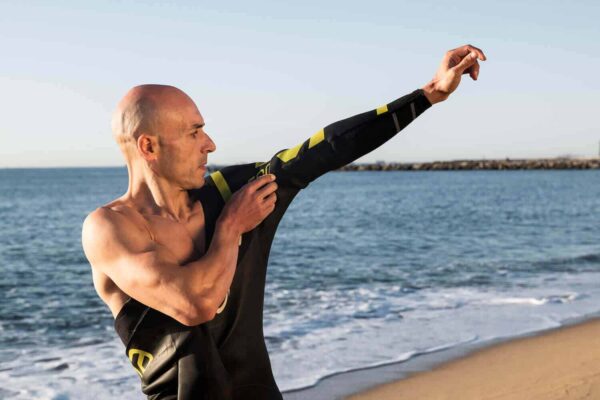
Step 4: Chest, arms and shoulders
- Once youre fitted up to your waist, next you will bring the suit up to your chest to insert your arms.
Back-Zip Wetsuits
NOTE: Back-zip wetsuits will give the most room to get your arms and shoulders in.
- In much the same way as you worked the neoprene up your legs, apply the same method when inserting your arms.
- One arm at a time, remove any ruckles/ripples/folds in the neoprene as you go.
- Once your arms are in, pull and lift the chest into place so it’s comfortable and aligned with your body, under the arms and around the neck, just like you did with the legs around your crotch.
Chest-Zip & Zip-Free Wetsuits
- These suits are slightly more challenging in that you will be able to raise the suit to your chest/upper torso, as above, but then a little more wiggling is needed for your arms!
- To be able to get your arms in, you will need to force your arms down inside the chest cavity to find the arm opening, leaving the neck and upper closure either to one side, or to the rear depending on the model.
- Insert one arm at a time, using your free hand to pull the suit up & out to ease access. As with your legs, work the neoprene up your arm from the wrist, smoothing out any wrinkles/folds as you go. Repeat with the other side.
- Once youve got both arms in, adjust / lift the suit around your upper chest and shoulders into place, aligning the shaped areas such as under your arms, and also ensure any reinforced / padded areas are in the right location such as elbow pads etc.
- From here, you need to pull the neck piece over your head and into place.
- Usually these suits will feature two layers of neoprene at the area where the neck piece joins the main suit. The top panel being the neck piece itself, with the under layer being a continuation of the main suit, giving greater protection at this area where the water can enter. Take care that the under layer is ripple free and not caught up.
NOTE: Some wetsuits feature neck pieces which are integrated with the back and one of the shoulders, sometimes known as Slant-Zip Wetsuits, others will be integrated with the back only and some are totally removable, allowing switching of summer neck pieces and winter versions with hoods!
- Once you have pulled the neck piece over your head, as with the other zones on the wetsuit, adjust this panel to position comfortably before closing fully.
- TIP: remember, you dont want excess material on the upper part of your suit either (ripples/folds/rolls) as these will stop the suit insulating you correctly. Conversely, you also dont want the suit to be too tight as this will stop water from reaching certain areas of your body also failing to keep you warm.

Step 5: Seeking closure
Back-Zip Wetsuits
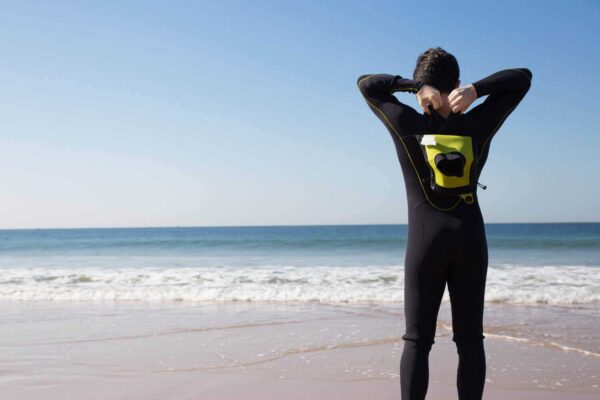
- TIP: If this is the first time youre trying on a wetsuit, its handy to have a second pair of hands to close the zip as its behind you! Locating the zip leash can be challenging until youve practised and if the zip is pulled at an odd angle, this can stress the neoprene and the zip itself.
- To help the zip close without putting too much strain on each side, it is helpful to rotate your shoulders backwards (sticking your chest out), bringing your shoulders as close together as possible (no previous yoga experience necessary, we promise!).
- Pull up the zip to the very top, as far as it will go.
- Normally you will have a velcro fastener at the top of the neck. This usually serves two purposes a) to secure the zip leash to stop it flailing over your shoulder, getting in the way and b) to seal the neck securely to prevent water flowing in and flushing the suit thus making you cold.
Chest-Zip Wetsuits
- Whether your chest-zip is a one-sided affair (i.e. the neck-panel is integrated with the back and one of the shoulders as in a slant-zip wetsuit) or its a fully removable neck piece, the principle is the same.
- Ensure your neck piece is comfortable and all of the panels which sit underneath this are smoothed out and not caught up / ruckled.
- Align the zippers and close fully.
- Sometimes you will also have a pull toggle to prevent flushing down the open side/s – go ahead and adjust this, just enough so there are no gaping areas of neoprene down the edge/s.
TIP: If you are trying on a chest-zip wetsuit for the first time and it features a neck panel which is only integrated with the back, it is helpful to have a second pair of hands to pass this piece to you, over your head! If nobody is available, you will likely develop an interesting new kind of dance to fling this up and over your head (suggestion: avoid anyone with a camera until fully practised)!!
Zip-Free Wetsuits
- The neck piece of most zip-free suits will be integrated with the back, chest and one shoulder, leaving just the remaining shoulder to close up.
- Once you have smoothed out all the neoprene up to your shoulders, simply pull the neck piece over your head, trying to do this with as little stretching of the neoprene as possible.
- Once the neck piece is over your head, adjust as before, aligning the seams relative to your body and generally to feel as comfortable as possible.
- To close, ensure the panels of neoprene which sit below the neck piece are not folded/ruckled and then pull the toggle closure to tighten.
TIP: The toggle closures should not be tightened so much that they are really taught, the idea is that they are tight enough to create a barrier over the open side/edge.
Step 6: Is it a deal?
Now youve got into your wetsuit its time to discover whether its the right fit!
TIP: If there are any baggy areas of neoprene hanging off of you – its not the right fit. Try another
The best way to test if your wetsuit is comfortable is to move around! Yes youve guessed it – pretend youre at a concert watching your favourite band whilst also doing yoga – wave your arms around like a windmill, do some star jumps, bring your knees to your chest, sit down, squat down, stand up, touch your toes, twist sideways, rotate your torso to the front and back, do front-crawl / lie down and paddle! If you can do a cartwheel – be our guest!
In brief, it should fit like a second skin. There should be no excess material or baggy areas. The suit should also not be restrictive or squeezing you – if this is the case, it may be too small.
FYI: All the articulation points, such as your knees, hips, elbows, underarms should have the flexibility to move freely. Because you are moving in these areas, a suit which doesnt fit properly can rub and cause friction burns, so take care to notice if the neoprene has sufficient flex and is soft against your skin and most importantly doesnt have excess material here.

Getting out of a wetsuit
So it fits (hooray), or perhaps its time to try a different model – either way you will need to get out of your wetsuit at some point!
Getting out of wetsuit is pretty much the reverse of putting it on, but with a few considerations:
- Undo all closures – zips as far as they will go / release all velcro tabs / loosen off all pull toggles as far as possible)
- For chest-zip and zip-free suits, pull the neck piece over your head to release the neck/shoulder area.
- Next, remove one arm at a time. For chest-zip and zip-free suits, you might need a friend to help to release the first shoulder.
- Once your first shoulder is out, gently roll the wetsuit down towards your elbow, and on towards your wrist. Your first arm will then release.
- Repeat for your second arm, rolling the wetsuit down your body and removing by rolling the suit inside out.
- Take care not to damage your suit if you are standing on sharp stones or pebbles at the beach etc, as these could cut the neoprene.
- Et voila – youre out! If your suit is dry and brand new, then just turn it the right way round and hang up. If your suit is wet from a dip – remember to wash it out thoroughly and leave to dry inside out. (Check out our care guide for more tips on how to keep your wetsuit looking (and smelling) great!)